Why this exists
Processing should make the tradeoffs explicit.
Working with sub-bottom profiler data always involves a balance: improving clarity, preserving signal integrity, and understanding what processing is actually doing.
Pelagos was developed to make that balance more transparent, more structured, and more physically consistent.
The approach
Signal first.
Pelagos starts from a simple idea: processing should follow the physics of the signal. Each step builds on the previous one, and the flow is treated as a sequence, not a collection of unrelated actions.
- Detect the seabed
- Address source-related artifacts
- Define usable bandwidth
- Compensate attenuation with depth
- Enhance continuity where appropriate
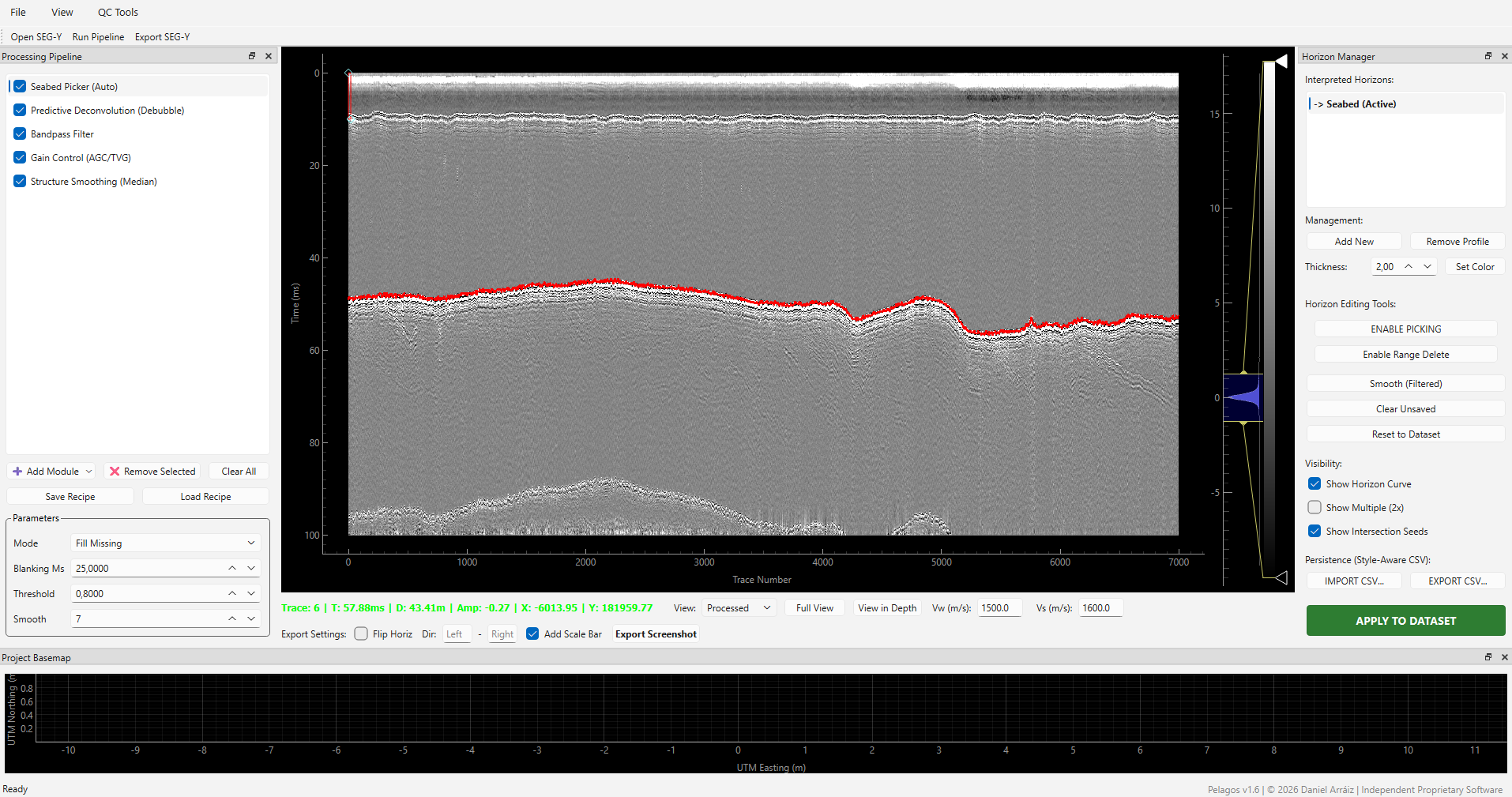
- Visualize for interpretation
Processing
Built around the source.
Different sources require different approaches. Pelagos separates workflows so each source can be treated according to its physical behavior.
Boomer / Sparker: reduce bubble-related artifacts while preserving primary reflections.
Chirp: recover vertical resolution from the transmitted sweep without losing physical meaning.
Visualization and interpretation
See clearly. Interpret deliberately.
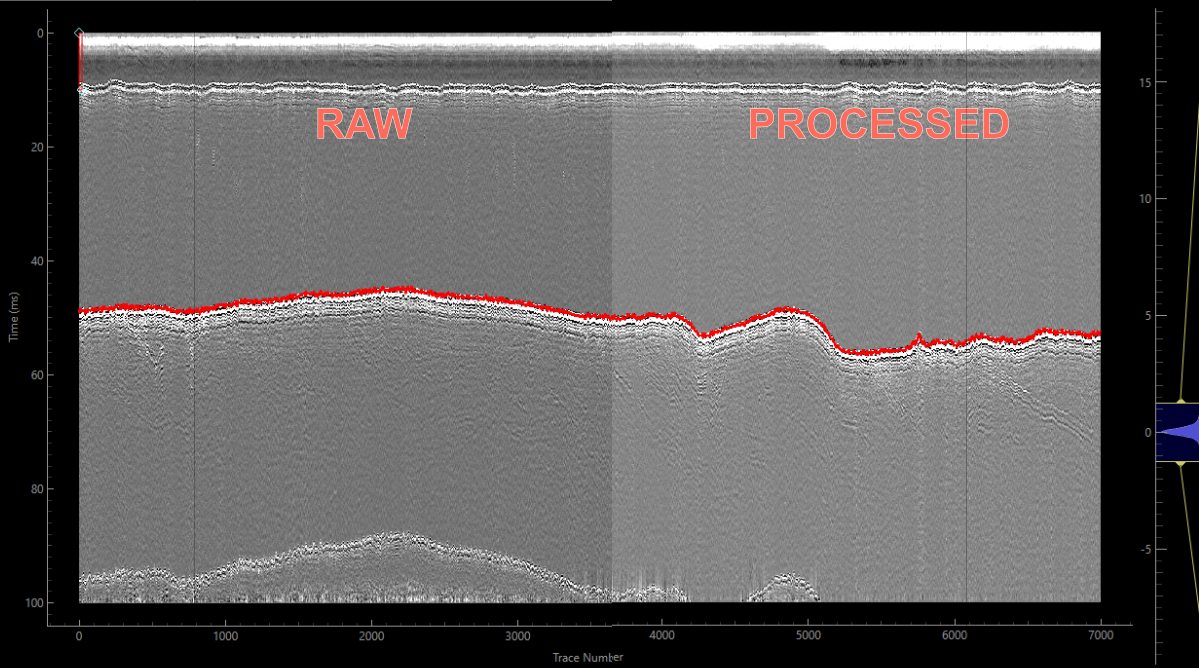
Display tools are separated from processing logic. They help inspect the data through real-time echograms, raw-versus-processed comparison, spectrum analysis, seabed picking, and horizon digitization, without redefining the signal itself.
Processing should reflect how the signal behaves. From there, interpretation becomes clearer not because the data is simplified, but because it is better understood.